

Within military modernization processes, discussions usually focus on technology, strategy, and operational capacity. However, there is one element that truly determines the behavior of an armed organization: the human quality of its leaders.
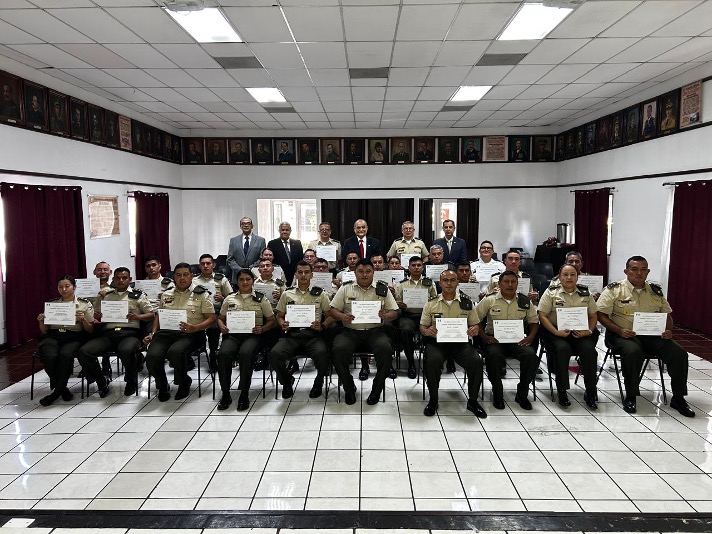
I had the opportunity to develop a transformational leadership program for officers of the Guatemalan Army, whose primary purpose was neither tactical nor technical, but deeply human — to approach leadership through character formation, conscious decision-making, and spiritual strengthening.
The approach was based on a simple premise:
armies do not only need trained officers, but balanced leaders.
Beyond discipline: inner leadership
Armed forces are trained to act under pressure, make rapid decisions, and respond to critical situations. Yet technical capacity does not always guarantee leadership.
An officer may hold authority…
but not necessarily positive influence.
The program addressed aspects rarely included in traditional military education:
- self-awareness
- emotional management under high pressure
- ethics in decision-making
- leading by example
- managing fear and uncertainty
- moral responsibility associated with power
The intention was to develop leadership that does not depend solely on rank, but on personal credibility.
Spirituality as institutional strength
One of the central components was spiritual strengthening, understood not from a specific religious perspective, but as the construction of meaning, purpose, and personal coherence.
A leader without inner stability may act correctly in times of calm, yet fail in times of crisis.
Topics included:
- personal purpose and vocation of service
- emotional resilience
- operational stress management
- sense of duty
- balance between authority and humanity
- impact of decisions on civilian populations
The objective was to help officers understand that military leadership does not only manage resources or troops — it manages human lives.
Power and responsibility
Armed organizations have a unique characteristic: they possess the real capacity to exercise power. For this reason, military leadership requires a higher level of awareness than most organizational structures.
The training encouraged reflection on:
- proportional use of force
- ethical responsibility of command
- authority with empathy
- leadership in complex social contexts
- relationship with the community
When an officer understands the impact of his or her decisions, the style of command changes completely.
Multiplying impact
Military leadership has an exponential effect. Each officer directly influences dozens or hundreds of personnel under their command, and indirectly affects thousands of citizens.
Strengthening a military leader improves not only an institution, but also the interaction between the State and society.
These formative processes pursue a clear objective:
that authority be perceived as protection, not imposition.
To lead is also to serve
At the end of the program, it became clear that technical preparation is essential but insufficient. Strong institutions are sustained not only by regulations, but by integrity.
Security does not depend only on weapons or technology.
It depends on who makes the decisions.
When leadership incorporates purpose, emotional balance, and awareness of social impact, institutions gain legitimacy, citizens gain trust, and stability is strengthened.
True leadership is not measured by military rank, but by the human impact left on those under one’s responsibility.

