

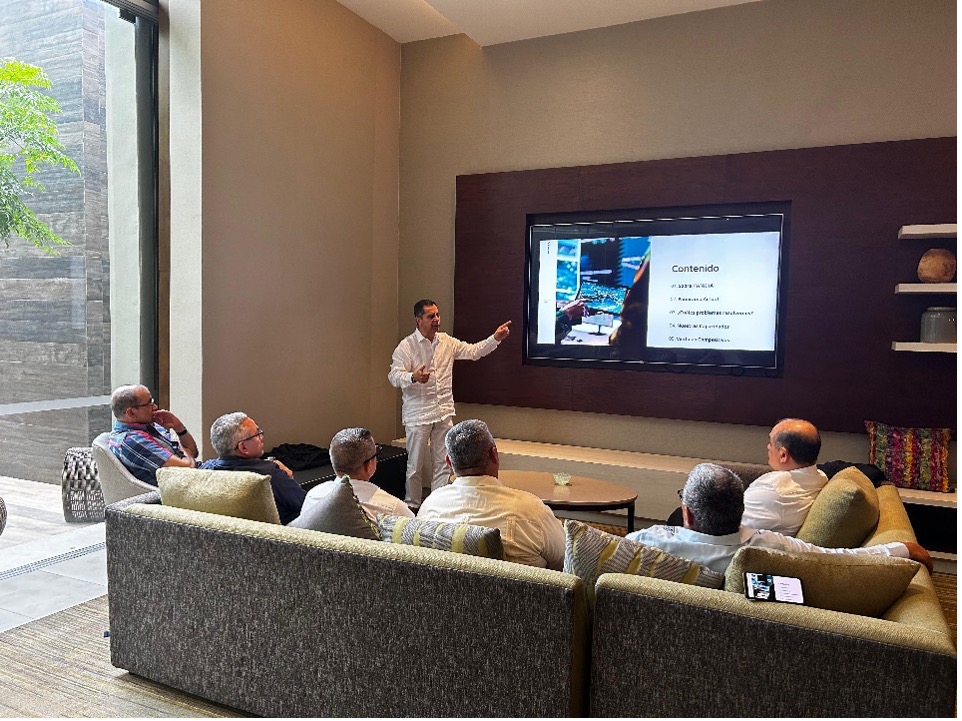
I recently had the honor of participating in a training program for Generals and senior commanders of the Guatemalan Army, focused on one of today’s greatest challenges: security in the technological era.
Security in the 21st century no longer depends solely on the operational capacity of armed forces. Today, a nation’s defense is also fought across servers, communication networks, surveillance systems, satellites, and data centers.
The reality is clear: conflicts have changed.
Currently, a cyberattack can be more destructive than a military intervention, and the manipulation of information can destabilize a state without a single projectile being fired. Within this context, the training was structured around three strategic pillars:
- Cybersecurity
- Tactical operation and analysis of drones
- Security for smart cities
Cybersecurity as national defense
For many years, territorial protection was the main concern of armies. Today, however, threats target invisible infrastructures: power systems, financial networks, telecommunications, state databases, and military communications.
A country can be paralyzed if it loses control of its information.
During the training we addressed topics such as:
- protection of critical infrastructure
- hybrid warfare
- cyber intelligence
- digital counterintelligence
- technological crisis management
The goal was not to teach computer science, but to understand that national sovereignty must also be protected in the digital domain.
Drones: information before force
Drones represent one of the greatest changes in modern military strategy. Beyond tactical use, they have become platforms for territorial intelligence.
Today they allow:
- border surveillance
- monitoring of rural areas
- control of illicit trafficking
- support during natural disasters
- early identification of threats
During the program, officers worked not only on operating the systems, but on something far more important: the strategic interpretation of aerial information.
A drone is not merely a flying device — it is an intelligence system.
The challenge of smart cities
Cities are moving toward connected models: cameras, sensors, data analytics, and centralized monitoring platforms. However, a connected city can also be vulnerable.
A poorly protected “smart city” can be digitally compromised.
Therefore, we addressed:
- urban monitoring centers
- integration between civil and military authorities
- predictive crime analytics
- video surveillance security
- coordinated emergency response
The urban security of the future will be preventive and data-driven, not only reactive.
Strategic education for social stability
Training senior military leaders impacts not only an institution, but an entire nation. Each trained officer becomes a multiplier of knowledge within academies, operational units, and training centers.
This translates into:
- improved prevention of organized crime
- greater emergency response capacity
- protection of civilian populations
- institutional strengthening
Education, when properly oriented, becomes a tool for social stability.
The role of knowledge in modern security
Today more than ever, security depends on knowledge.
Technology without leadership creates vulnerability; technology with preparation creates protection.
Armed forces around the world are recognizing that defense is not based solely on equipment, but on the education of their leaders.
Participating in this training process reaffirms something fundamental:
education does not only form professionals… it can also help protect societies.

