

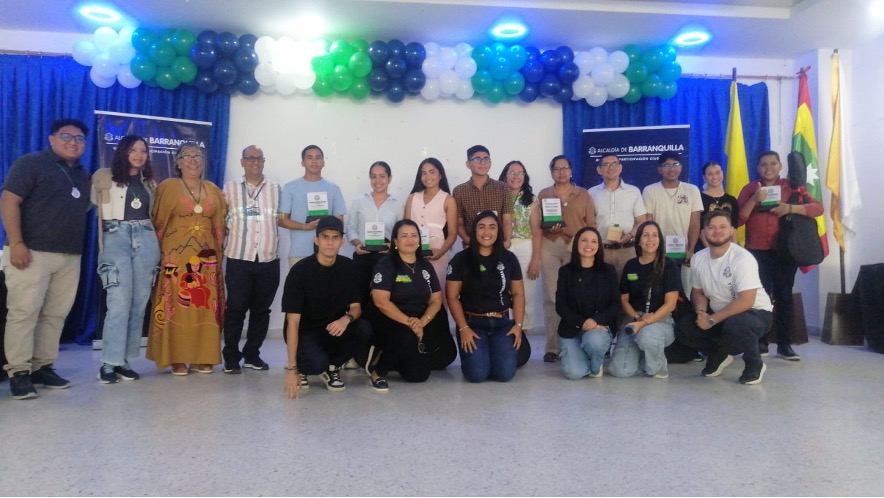
Forming citizens, not just students
For a long time, political apathy among young people has been widely discussed.
It is often said that they “do not participate,” “are not interested,” and “do not believe in institutions.” However, a deeper reality is rarely analyzed: participation cannot be demanded from those who have never been taught how to participate.
Civic participation does not arise spontaneously.
It is learned.
Under this premise, the Youth Participation component was developed — a training process that brought together more than 1,500 young people in a space designed not for speeches, but for real tools of social engagement.
The goal was not only to motivate them, but to train them as civic actors capable of understanding their environment and transforming it.
Participants were trained in leadership, citizen oversight, proposal development, and youth advocacy. This meant learning to identify community problems, structure solutions, engage with institutions, and communicate ideas in an organized and responsible way.
The training challenged a common paradigm: the belief that youth only need to be heard.
Here, the approach was different — young people learned how to make themselves heard with arguments.
They came to understand how participation spaces function, how viable social proposals are built, and how to exercise civic oversight with institutional respect. Communication skills, critical thinking, and collective responsibility were strengthened, reinforcing the idea that citizenship does not begin at age 18; it begins when a person understands they are also co-responsible for public life.
Beyond the workshops, the process achieved something even more important:
participants stopped seeing themselves only as students and began to see themselves as emerging community leaders.
Youth participation is not an event; it is a process.
And when properly guided, it not only forms leaders — it creates more aware, more dialogical, and more democratic communities.
Investing in youth is not about preparing the future.
It is about improving the present.

