

When politics is built with the people
Public policies are often understood as technical documents prepared by experts. However, a truly legitimate policy does not arise solely from an institutional desk, but from the everyday experience of those who live in the city.
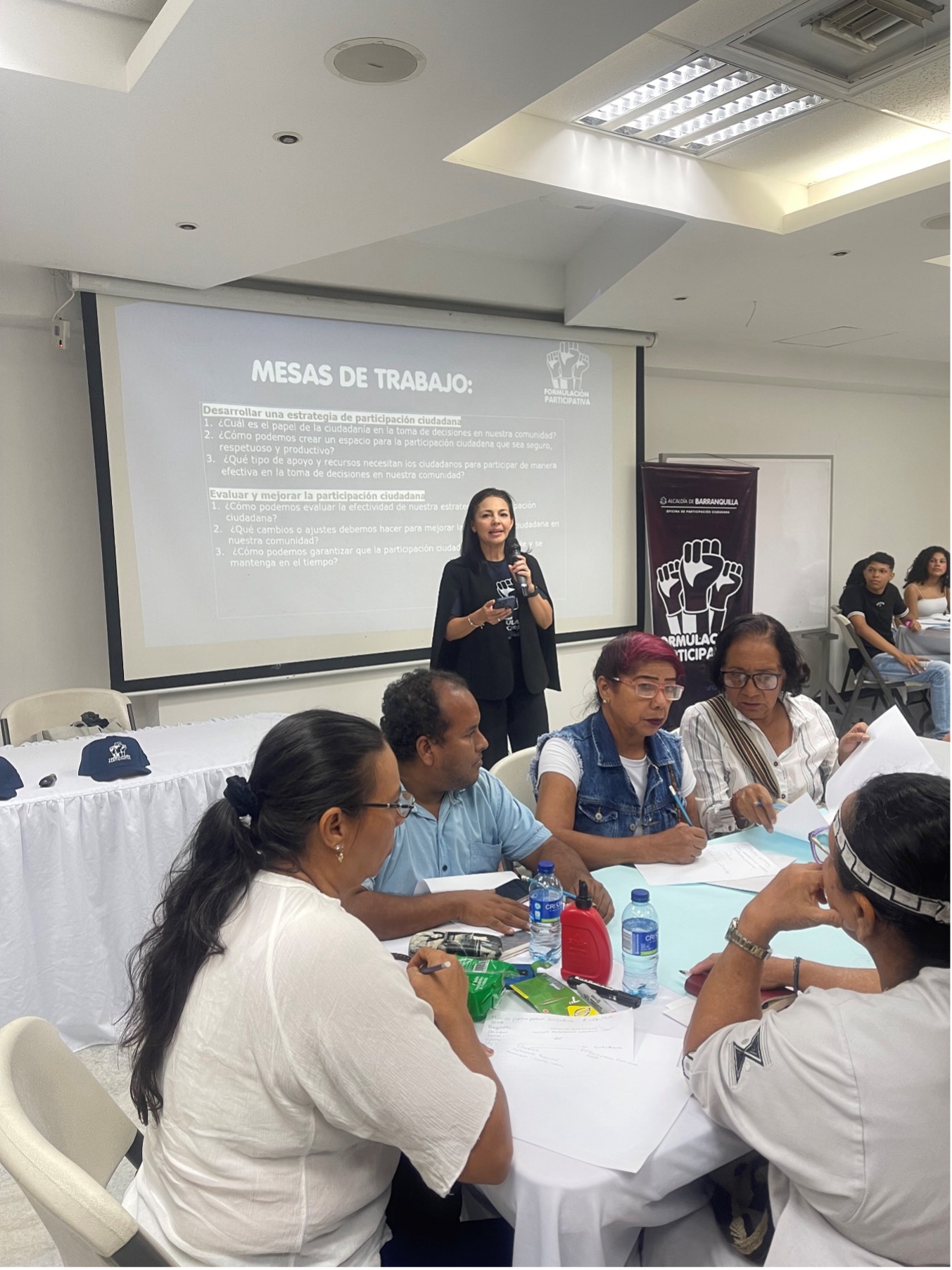
Under this vision, the Citizen Participation component was developed — a collaborative process that brought together 200 beneficiaries in Barranquilla to actively contribute to the construction of the district’s public policy on citizen participation.
The objective was not merely to present regulations, but to build them collectively.
Throughout the process, participants were trained in governance and democracy, learning how institutions function, what formal channels of civic influence exist, and how citizens can responsibly take part in public decision-making.
The training allowed a shift from opinion to proposal.
Participants did not only express problems; they learned how to structure them, prioritize them, and transform them into technical contributions for policy formulation.
This approach transformed the traditional role of the citizen —
from a recipient of decisions to a co-responsible actor in the city’s development.
The process also strengthened institutional trust. By understanding governance mechanisms, participants identified spaces for dialogue, social oversight, and cooperation between the community and public administration, reducing the distance between authorities and citizens.
Citizen participation is not limited to voting.
It involves understanding, deliberating, and collectively building solutions.
This initiative demonstrated that when communities are included from the design stage of public policies, decisions are no longer perceived as impositions but as social agreements.
Ultimately, a city is not governed only by regulations.
It is governed by informed, organized, and active citizens.
And Barranquilla moved forward on that path by understanding that democracy is not only exercised…
it is also learned.

